Publish your website as a public secured service
Requirements
- read the previous chapter Deploy abcdesktop on AWS with Amazon Elastic Kubernetes Service
- an AWS account
- your own internet domain
awscommand line interface aws-clikubectlcommand linehelmcommand line
Overview
In this chapter, you will use an NGINX ingress controller to expose your abcdesktop service with a public IP address, configure your DNS zone file to use your own domain name, and enable TLS to secure the service.
Add tags for public subnets
By default, when creating your VPC, the public subnets do not have the kubernetes.io/role/elb=1 tag. This tag is required to expose your service through an NGINX Ingress Controller on AWS, because AWS scans your VPC for subnets bearing this exact tag to determine where to place the ingress controller.
To add the tag, run the following command:
aws ec2 create-tags --resources <your_public_subnets_ids> --tags Key=kubernetes.io/role/elb,Value=1
You can find your public subnet IDs on the
Subnetspage of the VPC dashboard in the AWS console.
You can verify that the tags have been applied by running the following command:
aws ec2 describe-subnets --filters "Name=vpc-id,Values=<your_vpc_id>" "Name=tag:kubernetes.io/role/elb,Values=1" --query 'Subnets[*].[SubnetId,AvailabilityZone]' --output table
You should see the following output on stdout:
--------------------------------------------
|              DescribeSubnets             |
+---------------------------+--------------+
|  subnet-09c09bd5bbdec72a6 |  us-east-1b  |
|  subnet-02d592feab5bb0faf |  us-east-1a  |
+---------------------------+--------------+
Update http-router service
When installing abcdesktop, the http-router service type is NodePort by default. To expose the service through an ingress controller, you must change the service type from NodePort to ClusterIP.
If you perform a get services command you will see the NodePort type
kubectl get svc http-router -n abcdesktop
NAME          TYPE       CLUSTER-IP    EXTERNAL-IP   PORT(S)        AGE
http-router   NodePort   10.0.170.21   <none>        80:30443/TCP   5m31s
To change it, you will first need to delete the service
kubectl delete service http-router -n abcdesktop
service "http-router" deleted
Then paste the following lines in a new http-router.yaml file
kind: Service
apiVersion: v1
metadata:
  name: http-router
  labels:
    abcdesktop/role: router-od
spec:
  selector:
    run: router-od
  ports:
  - protocol: TCP
    port: 443
    targetPort: 443
    name: https
  - protocol: TCP
    port: 80
    targetPort: 80
    name: http
Then, apply your new service/http-router:
kubectl apply -f http-router.yaml -n abcdesktop
service/http-router created
Now check that the service type is ClusterIP
kubectl get svc http-router -n abcdesktop
NAME          TYPE        CLUSTER-IP     EXTERNAL-IP   PORT(S)          AGE
http-router   ClusterIP   10.0.132.230   <none>        443/TCP,80/TCP   5s
Deploy nginx ingress controller
You will now deploy an NGINX ingress controller on your cluster using helm.
First, run the following command to add the NGINX ingress controller repository:
helm repo add ingress-nginx https://kubernetes.github.io/ingress-nginx && helm repo update
Then install it on your cluster:
helm install ingress-nginx ingress-nginx/ingress-nginx --namespace ingress-nginx --create-namespace
Once installed, you can verify that the service has been created by running this command:
kubectl get svc ingress-nginx-controller -n ingress-nginx
NAME                                 TYPE           CLUSTER-IP      EXTERNAL-IP   PORT(S)                      AGE
ingress-nginx-controller             LoadBalancer   172.20.87.254   <pending>     80:32337/TCP,443:30414/TCP   34s
You will see that EXTERNAL-IP is <pending> for an extended period. This is completely normal because, by default, the controller treats your service as internal. To make it public, you should add annotations by running the following command:
kubectl annotate svc ingress-nginx-controller -n ingress-nginx service.beta.kubernetes.io/aws-load-balancer-scheme=internet-facing service.beta.kubernetes.io/aws-load-balancer-type=nlb --overwrite
Rerun the previous command until the service is assigned an EXTERNAL-IP:
kubectl get svc ingress-nginx-controller -n ingress-nginx
NAME                                 TYPE           CLUSTER-IP      EXTERNAL-IP                                                                     PORT(S)                      AGE
ingress-nginx-controller             LoadBalancer   172.20.87.254   k8s-ingressn-ingressn-dc31c08978-b7ef1bca03cfe45b.elb.us-east-1.amazonaws.com   80:32337/TCP,443:30414/TCP   3m
Create new record
Create a new DNS A record named hello (e.g., hello.aws.pepins.net) aliased to k8s-ingressn-ingressn-dc31c08978-b7ef1bca03cfe45b.elb.us-east-1.amazonaws.com.
First, retrieve the hosted zone ID of your load balancer by running the following command:
aws elbv2 describe-load-balancers --region us-east-1 --query 'LoadBalancers[0].CanonicalHostedZoneId'
You should receive output similar to the following:
Z26RNL4JYFTOTI
Paste the following content into a create-record-abcdesktop-aws.json file:
{
  "Comment": "create a new record for abcdesktop on aws",
  "Changes": [
    {
      "Action": "CREATE",
      "ResourceRecordSet": {
        "Name": "hello.aws.pepins.net.",
        "Type": "A",
        "AliasTarget": {
          "HostedZoneId": "<your_hosted_zone_id>",
          "DNSName": "k8s-ingressn-ingressn-dc31c08978-b7ef1bca03cfe45b.elb.us-east-1.amazonaws.com",
          "EvaluateTargetHealth": false
        }
      }
    }
  ]
}
Next, retrieve the hosted zone ID of your domain in Route 53. You can obtain it through the Route 53 web console or by running the following command:
aws route53 list-hosted-zones --query 'HostedZones[*].[Name,Id]' --output table
The output will look similar to the following:
--------------------------------------------------------
|                    ListHostedZones                   |
+------------------+-----------------------------------+
|  aws.pepins.net. |  /hostedzone/Z0710575SCBYT0OUKZP  |
+------------------+-----------------------------------+
Finally, run the following command to add the DNS record:
aws route53 change-resource-record-sets --hosted-zone-id <your_domain_hosted_zone_id> --change-batch file://create-record-abcdesktop-aws.json
For example:
aws route53 change-resource-record-sets --hosted-zone-id Z0710575SCBYT0OUKZP --change-batch file://create-record-abcdesktop-aws.json
The output will look similar to the following:
{
    "ChangeInfo": {
        "Id": "/change/C07091422RBO1K64I6QWN",
        "Status": "PENDING",
        "SubmittedAt": "2026-01-14T13:30:30.133000+00:00",
        "Comment": "create a new record for abcdesktop on aws"
    }
}
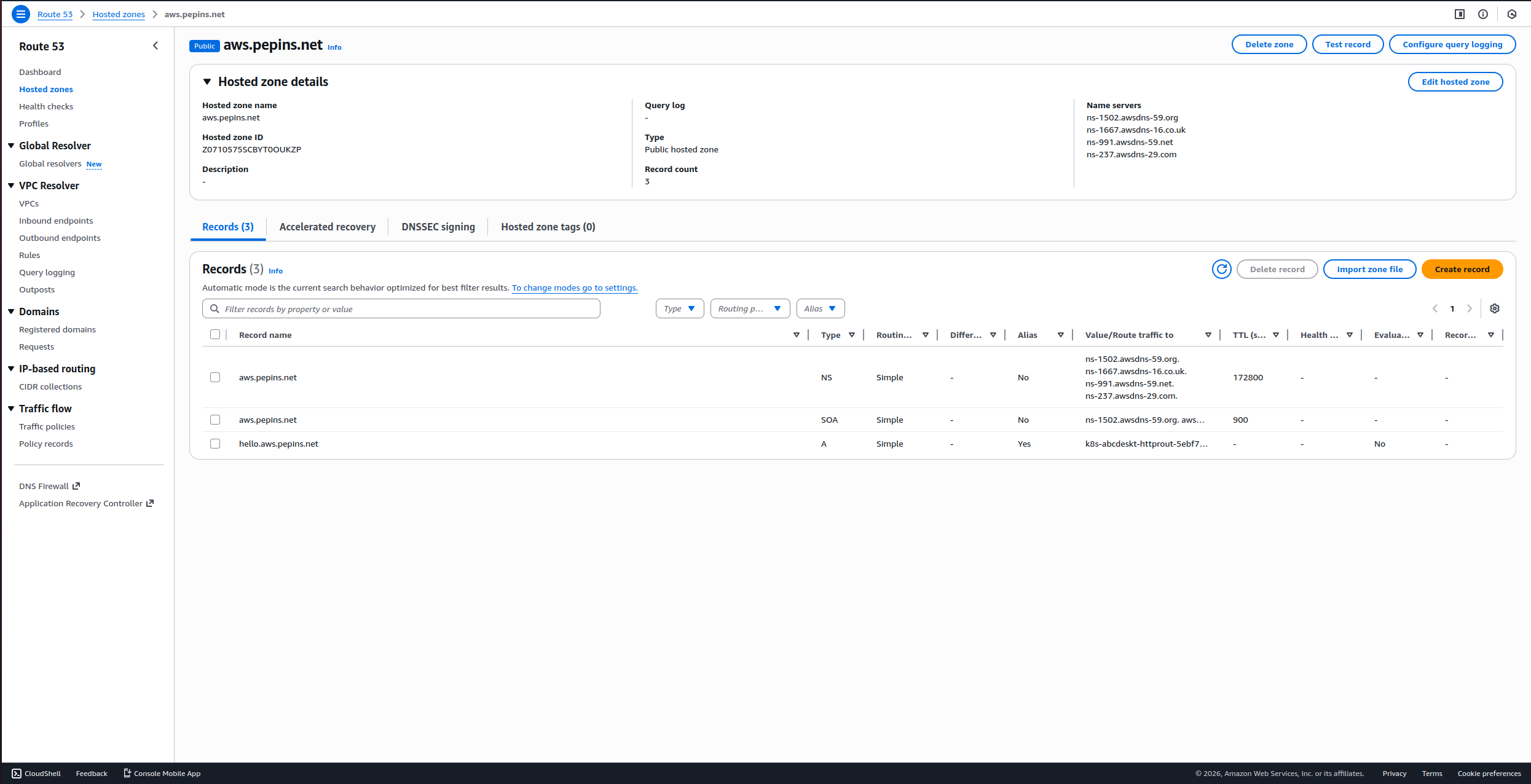
If you navigate to the Route 53 web console, you will see the newly added record.
Configure NGINX Ingress Rules for Backend Services
In this step, you expose the backend services to the outside world by telling NGINX what host each service maps to. You define a rule in NGINX that associates a hostname with the abcdesktop route backend service.
Create an ingress resource for NGINX using the abcdesktop service and save it as abcdesktop_host.yaml. Replace hello.aws.pepins.net with your own FQDN before applying.
apiVersion: networking.k8s.io/v1
kind: Ingress
metadata:
  name: ingress-abcdesktop
  namespace: abcdesktop
spec:
  rules:
    - host: hello.aws.pepins.net
      http:
        paths:
          - path: /
            pathType: Prefix
            backend:
              service:
                name: http-router
                port:
                  number: 80
  ingressClassName: nginx
Apply the Ingress yaml file
kubectl apply -f abcdesktop_host.yaml -n abcdesktop
You should read
ingress.networking.k8s.io/ingress-abcdesktop created
Verify the ingress resources:
kubectl get ingress -n abcdesktop
The output looks similar to the following:
Wait a few seconds while the ADDRESS field is empty
NAME                 CLASS   HOSTS                           ADDRESS   PORTS   AGE
ingress-abcdesktop   nginx   hello.aws.pepins.net                      80      24s
When you obtain an IP ADDRESS
NAME                 CLASS   HOSTS                           ADDRESS                                                                         PORTS   AGE
ingress-abcdesktop   nginx   hello.aws.pepins.net            k8s-ingressn-ingressn-dc31c08978-b7ef1bca03cfe45b.elb.us-east-1.amazonaws.com   80      3m13s
The spec section of the manifest contains a list of host rules used to configure the Ingress. If unspecified, or no rule matches, all traffic is sent to the default backend service. The manifest has the following fields:
-
host specifies the fully qualified domain name of a network host, for example echo.
<your-domain-name>. -
http contains the list of HTTP selectors pointing to backends.
-
paths provides a collection of paths that map requests to backends.
In the example above, the ingress resource instructs NGINX to route each HTTP request using the / prefix for the hello.aws.pepins.net host to the route backend service running on port 80. In other words, every request to http://hello.aws.pepins.net/ is served by the http-router backend service on port 80.
You can have multiple ingress controllers per cluster. The ingressClassName field in the manifest differentiates between them. You can also define multiple rules for different hosts and paths within a single ingress resource.
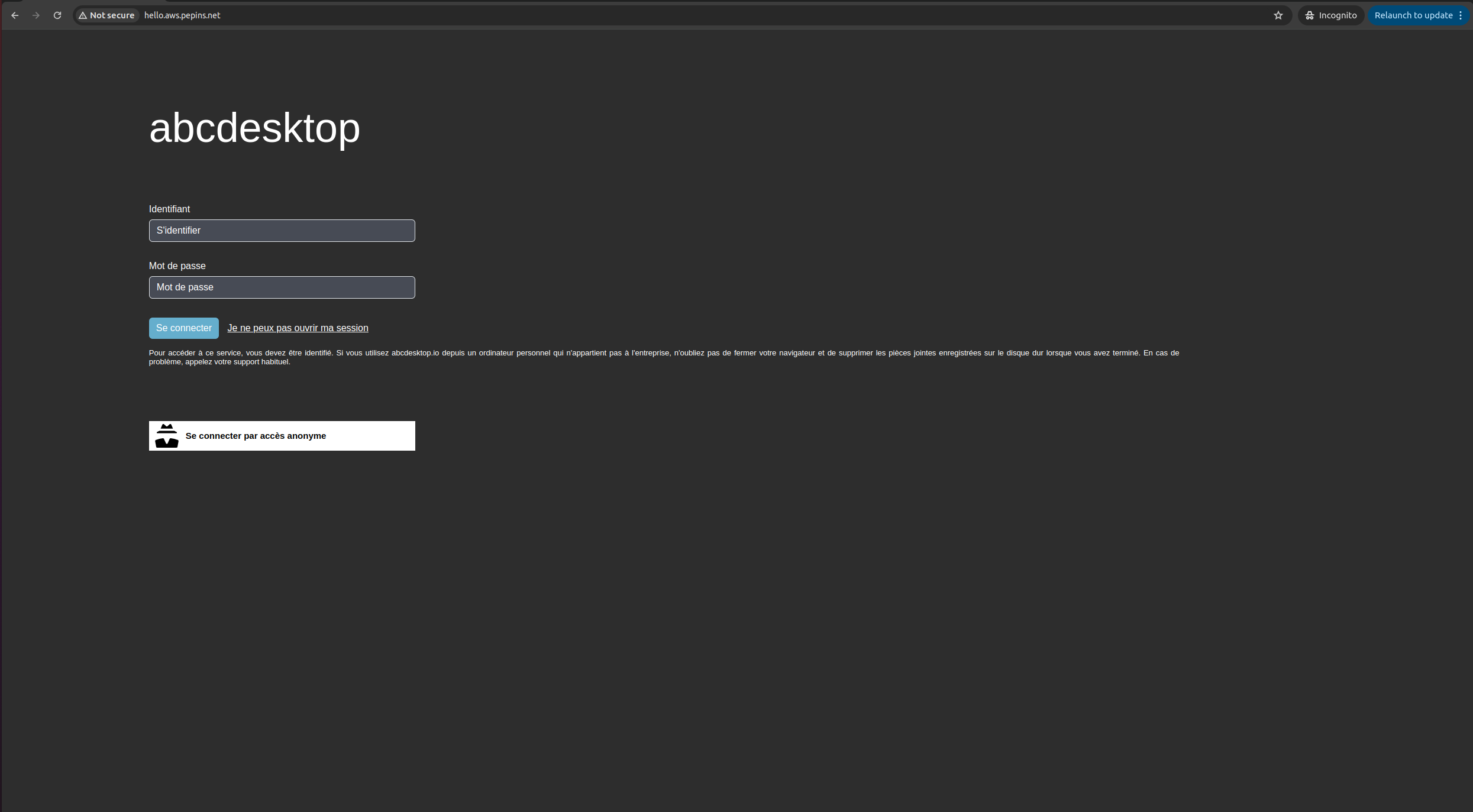
Web browsers do not permit WebSocket connections over an insecure protocol. To log in, you must use the
httpsprotocol.
As you can see, the website is marked Not Secured. The next step adds an X.509 SSL certificate to secure the service.
Enable HTTPS
Install Cert Manager add-on on AWS EKS marketplace
Navigate to the Add-ons section of your cluster in the AWS console, then click Get more add-ons and install Cert Manager.
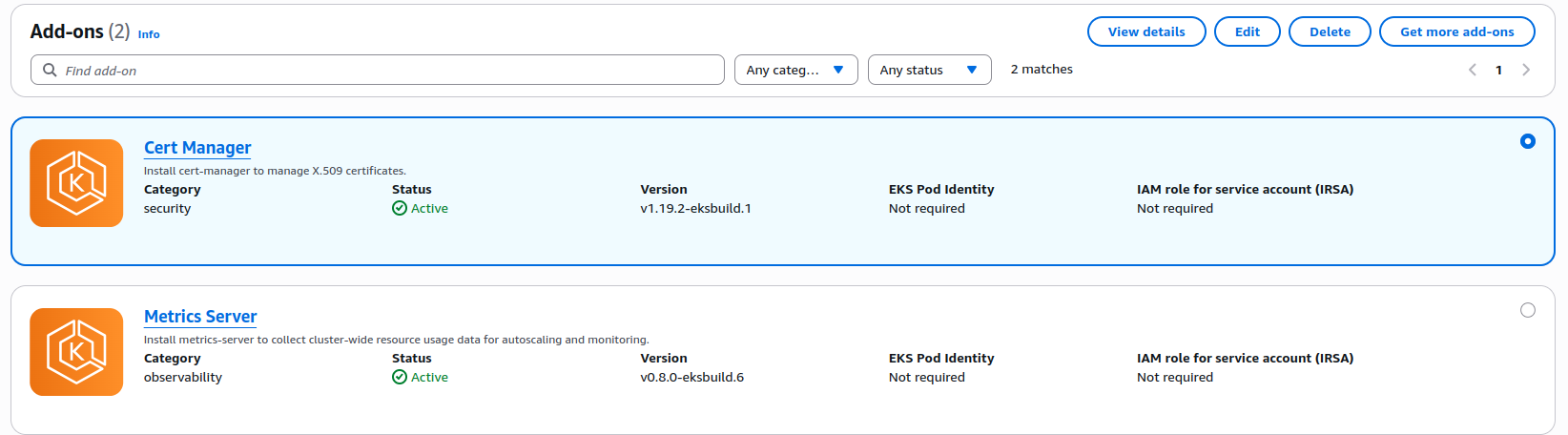
Once installed, you can inspect the Kubernetes resources created by Cert Manager:
kubectl get all -n cert-manager
The output looks similar to the following
NAME                                           READY   STATUS    RESTARTS   AGE
pod/cert-manager-76f99d9cbb-z5dgj              1/1     Running   0          3h26m
pod/cert-manager-76f99d9cbb-z7jnv              1/1     Running   0          3h26m
pod/cert-manager-cainjector-558b47dbf9-h55gx   1/1     Running   0          3h26m
pod/cert-manager-cainjector-558b47dbf9-lvgzl   1/1     Running   0          3h26m
pod/cert-manager-webhook-7db584cc6c-9qz5q      1/1     Running   0          3h26m
pod/cert-manager-webhook-7db584cc6c-l5s58      1/1     Running   0          3h26m

NAME                              TYPE        CLUSTER-IP       EXTERNAL-IP   PORT(S)            AGE
service/cert-manager              ClusterIP   172.20.196.196   <none>        9402/TCP           3h26m
service/cert-manager-cainjector   ClusterIP   172.20.102.95    <none>        9402/TCP           3h26m
service/cert-manager-webhook      ClusterIP   172.20.105.49    <none>        443/TCP,9402/TCP   3h26m

NAME                                      READY   UP-TO-DATE   AVAILABLE   AGE
deployment.apps/cert-manager              2/2     2            2           3h26m
deployment.apps/cert-manager-cainjector   2/2     2            2           3h26m
deployment.apps/cert-manager-webhook      2/2     2            2           3h26m

NAME                                                 DESIRED   CURRENT   READY   AGE
replicaset.apps/cert-manager-76f99d9cbb              2         2         2       3h26m
replicaset.apps/cert-manager-cainjector-558b47dbf9   2         2         2       3h26m
replicaset.apps/cert-manager-webhook-7db584cc6c      2         2         2       3h26m
The cert-manager pods and webhook service are running.
Cert-Manager creates custom resource definitions (CRDs). Cert-Manager relies on three important CRDs to issue certificates from a Certificate Authority (such as Let’s Encrypt):
Issuer: Defines a namespaced certificate issuer, which allows you to use different CAs in each namespace.
ClusterIssuer: Similar to Issuer, but it does not belong to a namespace and can be used to issue certificates in any namespace.
Certificate: Defines a namespaced resource that references an Issuer or ClusterIssuer for issuing certificates.
Inspect the CRDs by running the following command:
kubectl get crd -l app.kubernetes.io/name=cert-manager
The output looks similar to the following:
NAME                                  CREATED AT
certificaterequests.cert-manager.io   2026-01-19T10:23:33Z
certificates.cert-manager.io          2026-01-19T10:23:34Z
challenges.acme.cert-manager.io       2026-01-19T10:23:33Z
clusterissuers.cert-manager.io        2026-01-19T10:23:34Z
issuers.cert-manager.io               2026-01-19T10:23:34Z
orders.acme.cert-manager.io           2026-01-19T10:23:33Z
Configure Production-Ready TLS Certificates for nginx
Configure a Cert-Manager Issuer resource that fetches TLS certificates for NGINX using the HTTP-01 challenge provider.
Create the following manifest, replace <your-valid-email-address> with your own email address, and save it as cert-manager-issuer.yaml:
apiVersion: cert-manager.io/v1
kind: Issuer
metadata:
  name: letsencrypt-nginx
spec:
  acme:
    email: <your-valid-email-address>
    server: https://acme-v02.api.letsencrypt.org/directory
    privateKeySecretRef:
      name: letsencrypt-nginx-private-key
    solvers:
      # Use the HTTP-01 challenge provider
      - http01:
          ingress:
            class: nginx
The ACME issuer configuration has the following fields:
email: Email address to be associated with the ACME account. server: URL used to access the ACME server’s directory endpoint. privateKeySecretRef: Kubernetes secret to store the automatically generated ACME account private key.
The ingress resources use the HTTP-01 challenge.
kubectl apply -f cert-manager-issuer.yaml -n abcdesktop
The output looks similar to the following:
issuer.cert-manager.io/letsencrypt-nginx created
Verify that the Issuer resource is created:
kubectl get issuer -n abcdesktop
The output looks similar to the following:
NAME                READY   AGE
letsencrypt-nginx   True    7s
Next, configure the NGINX ingress resource to use TLS. Open the abcdesktop_host.yaml manifest, add the annotations and tls sections shown below, and save the file. You can also add nginx.ingress.kubernetes.io annotations to increase default timeout values. Replace hello.aws.pepins.net with your own FQDN:
apiVersion: networking.k8s.io/v1
kind: Ingress
metadata:
  name: ingress-abcdesktop
  namespace: abcdesktop
  annotations:
   cert-manager.io/issuer: letsencrypt-nginx
   nginx.org/client-max-body-size: "256M"
   nginx.ingress.kubernetes.io/proxy-connect-timeout: "30"
   nginx.ingress.kubernetes.io/proxy-read-timeout: "1800"
   nginx.ingress.kubernetes.io/proxy-send-timeout: "1800"
   nginx.ingress.kubernetes.io/proxy-body-size: "256M"
spec:
  tls:
   - hosts:
     - hello.aws.pepins.net
     secretName: letsencrypt-nginx-echo
  rules:
    - host: hello.aws.pepins.net
      http:
        paths:
          - path: /
            pathType: Prefix
            backend:
              service:
                name: http-router
                port:
                  number: 80
  ingressClassName: nginx
Run the following command to configure the hosts to use TLS:
kubectl apply -f abcdesktop_host.yaml -n abcdesktop
After a few minutes, check the state of the ingress object:
kubectl get ingress -n  abcdesktop
NAME                 CLASS   HOSTS                  ADDRESS                                                                         PORTS     AGE
ingress-abcdesktop   nginx   hello.aws.pepins.net   k8s-ingressn-ingressn-dc31c08978-b7ef1bca03cfe45b.elb.us-east-1.amazonaws.com   80, 443   42m
You see that 443 has appeared in the PORTS section.
Verify that the certificate resource has been created:
kubectl get certificates -n abcdesktop
The output looks similar to the following:
NAME                     READY   SECRET                   AGE
letsencrypt-nginx-echo   True    letsencrypt-nginx-echo   3m27s
Run the following curl command to confirm that your secured abcdesktop service is running:
curl -Li https://hello.aws.pepins.net/
HTTP/2 200
date: Mon, 19 Jan 2026 14:06:46 GMT
content-type: text/html
content-length: 56291
vary: Accept-Encoding
last-modified: Tue, 16 Dec 2025 11:52:18 GMT
etag: "694147f2-dbe3"
accept-ranges: bytes
x-frame-options: SAMEORIGIN
x-xss-protection: 1; mode=block
strict-transport-security: max-age=31536000; includeSubDomains

<!doctype html>
...
Reach your website using https protocol
You can now connect to your public abcdesktop website using https protocol.
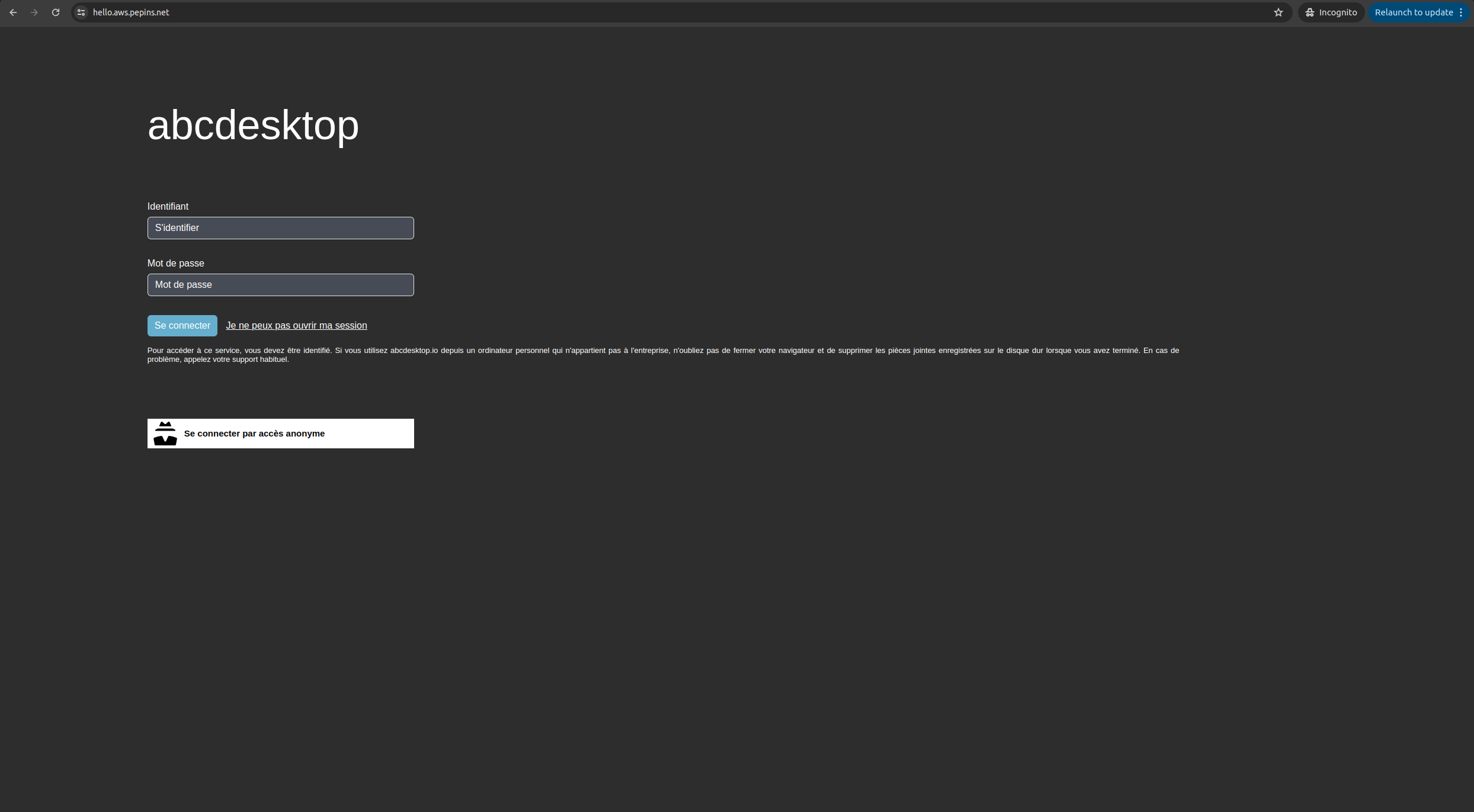
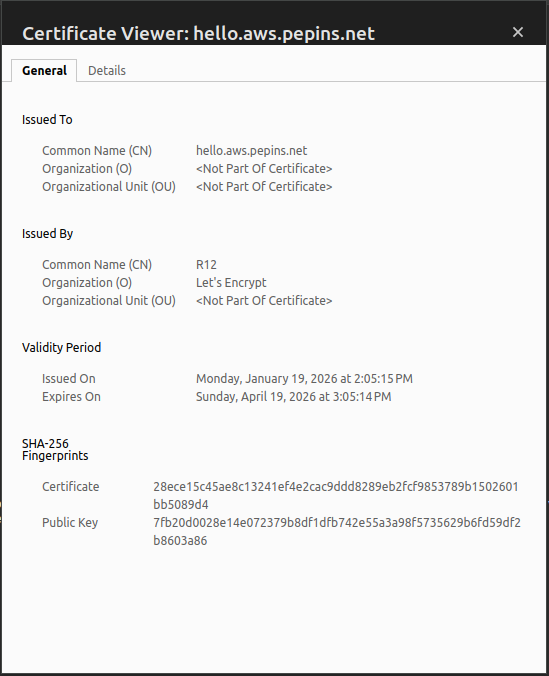
The status is secured and we get some information from the certificate
See real client IP address behind ingress controller
Now that your application is publicly exposed, you may be wondering about security and traffic inside your cluster.
For example, the console module of abcdesktop should not be accessible to everyone, as it is designed to be an administrator console. That is why, when you install abcdesktop, there is a pool of permitted IP addresses specified in the od.config file.
ManagerController': { 'permitip': [ '10.0.0.0/8', '172.16.0.0/12', '192.168.0.0/16', 'fd00::/8', '169.254.0.0/16', '127.0.0.0/8' ] }
By default, the configuration only permits private networks as defined in RFC 1918 and RFC 4193. Because your service is publicly exposed, none of your visitors should be able to access the console. However, you may find that you can access the console normally, which is not the expected behavior.
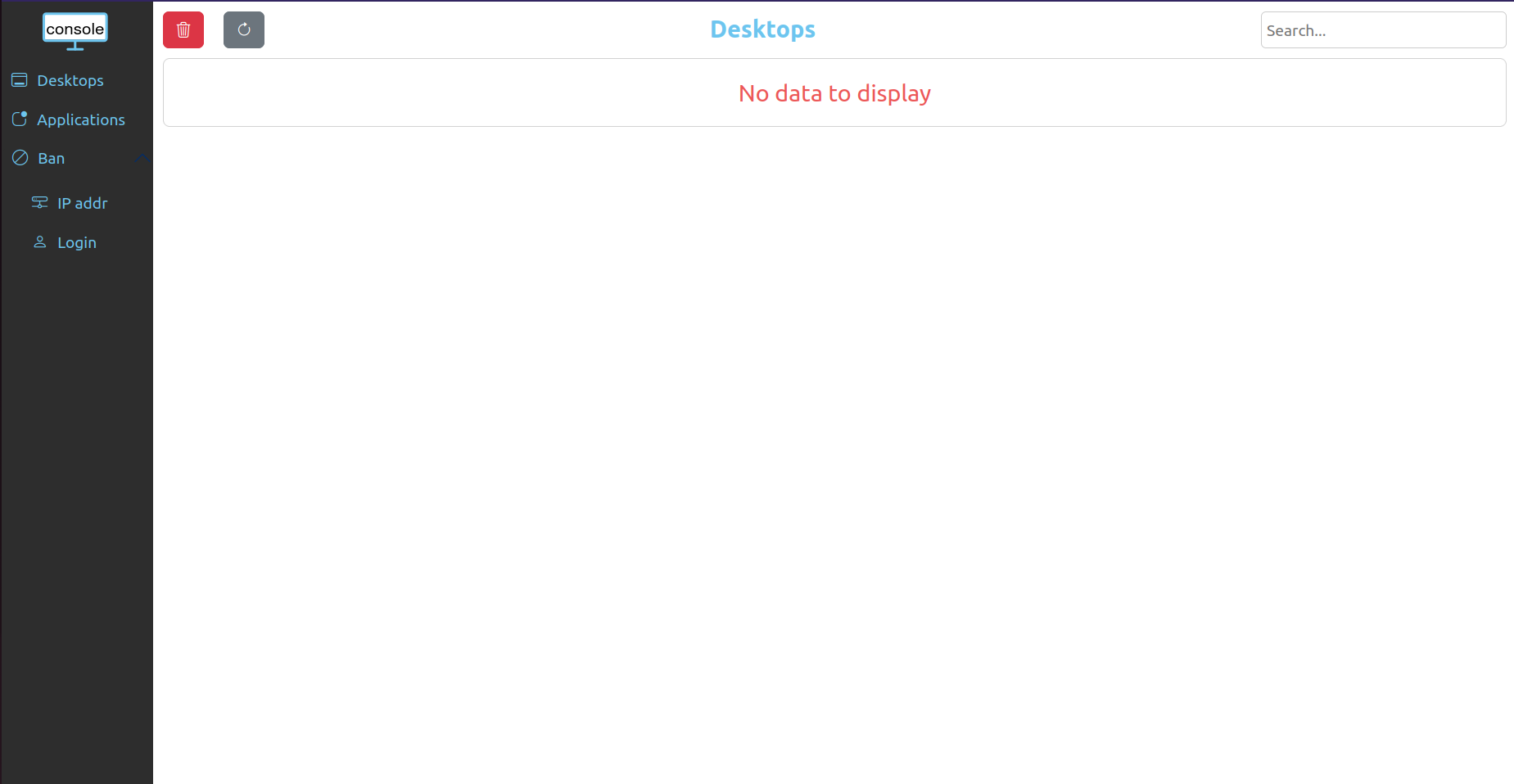
And when you check Pyos logs you will see why console behaves like that.
kubectl get pods -n abcdesktop
NAME                            READY   STATUS    RESTARTS   AGE
console-od-5cd84fdd69-zbjxf     1/1     Running   0          11m
memcached-od-6ccd5b5f67-wwnw8   1/1     Running   0          11m
mongodb-od-0                    2/2     Running   0          11m
nginx-od-784885cbd5-b7dqx       1/1     Running   0          11m
openldap-od-bb485cb4b-2ltm8     1/1     Running   0          11m
pyos-od-5c5cfdbfc8-t9r9m        1/1     Running   0          11m
router-od-6b7456b789-dsqdh      1/1     Running   0          11m
speedtest-od-8686c67749-hncft   1/1     Running   0          11m
kubectl exec -it pyos-od-5c5cfdbfc8-t9r9m -n abcdesktop -- bash
Defaulted container "pyos" out of: pyos, wait-for-mongo (init)
pyos-od-5c5cfdbfc8-t9r9m:/var/pyos# tail logs/trace.log
2026-02-06 16:03:51 abcpool1-node-fa2594 139923622185784 base_controller [DEBUG  ] controllers.manager_controller.ManagerController.apifilter:anonymous
2026-02-06 16:03:51 abcpool1-node-fa2594 139923622185784 base_controller [DEBUG  ] controllers.manager_controller.ManagerController.ipfilter:anonymous
2026-02-06 16:03:51 abcpool1-node-fa2594 139923622185784 base_controller [DEBUG  ] controllers.manager_controller.ManagerController.ipfilter:anonymous ipsource 10.2.1.0 is permited in network 10.0.0.0/8
2026-02-06 16:03:51 abcpool1-node-fa2594 139923622185784 manager_controller [DEBUG  ] controllers.manager_controller.ManagerController.handle_desktop_GET:anonymous
2026-02-06 16:03:51 abcpool1-node-fa2594 139923622185784 orchestrator [DEBUG  ] oc.od.orchestrator.ODOrchestratorKubernetes.__init__:anonymous load_incluster_config done
2026-02-06 16:03:51 abcpool1-node-fa2594 139923622185784 od [INFO   ] __main__.trace_response:anonymous /manager/desktop b'[]'
2026-02-06 16:03:55 abcpool1-node-fa2594 139923627645752 od [INFO   ] __main__.trace_request:anonymous /healthz
2026-02-06 16:04:05 abcpool1-node-fa2594 139923618954040 od [INFO   ] __main__.trace_request:anonymous /healthz
2026-02-06 16:04:15 abcpool1-node-fa2594 139923617876792 od [INFO   ] __main__.trace_request:anonymous /healthz
2026-02-06 16:04:25 abcpool1-node-fa2594 139923621108536 od [INFO   ] __main__.trace_request:anonymous /healthz
As you can see in the logs, the source IP address seen by Pyos is a private IP address such as 10.X.X.X (within the subnet defined as internal to your cluster), which falls within the pool of permitted IP addresses.
That happens because the NGINX Ingress Controller we set up earlier does not forward the client's public IP address; instead, it balances requests using its own cluster IP address. As a result, both Router and Pyos see the IP address of the ingress controller load balancer.
To fix this, update the NGINX Ingress Controller configuration. Paste the following content into a patch-ingress.yaml file:
controller:
  service:
    externalTrafficPolicy: "Local"
    annotations:
      service.beta.kubernetes.io/aws-load-balancer-type: "nlb"
      service.beta.kubernetes.io/aws-load-balancer-scheme: "internet-facing"
      service.beta.kubernetes.io/aws-load-balancer-nlb-target-type: "ip"
      service.beta.kubernetes.io/aws-load-balancer-proxy-protocol: "*"
      service.beta.kubernetes.io/aws-load-balancer-target-group-attributes: "proxy_protocol_v2.enabled=true,preserve_client_ip.enabled=true"
  config:
    use-proxy-protocol: "true"
    real-ip-header: "proxy_protocol"
    proxy-real-ip-cidr: "10.0.0.0/8"
    log-format-upstream: '{"time": "$time_iso8601", "remote_addr": "$proxy_protocol_addr", "x_forwarded_for": "$proxy_add_x_forwarded_for", "http_x_forwarded-for": "$http_x_forwarded_for", "request_id": "$req_id", "remote_user": "$remote_user", "bytes_sent": $bytes_sent, "request_time": $request_time, "status": $status, "vhost": "$host", "request_proto": "$server_protocol", "path": "$uri", "request_query": "$args", "request_length": $request_length, "method": "$request_method", "http_referrer": "$http_referer",  "http_user_agent": "$http_user_agent" }'
Run the following command to apply it:
helm upgrade ingress-nginx ingress-nginx/ingress-nginx -n ingress-nginx -f patch-loadbalancer.yaml
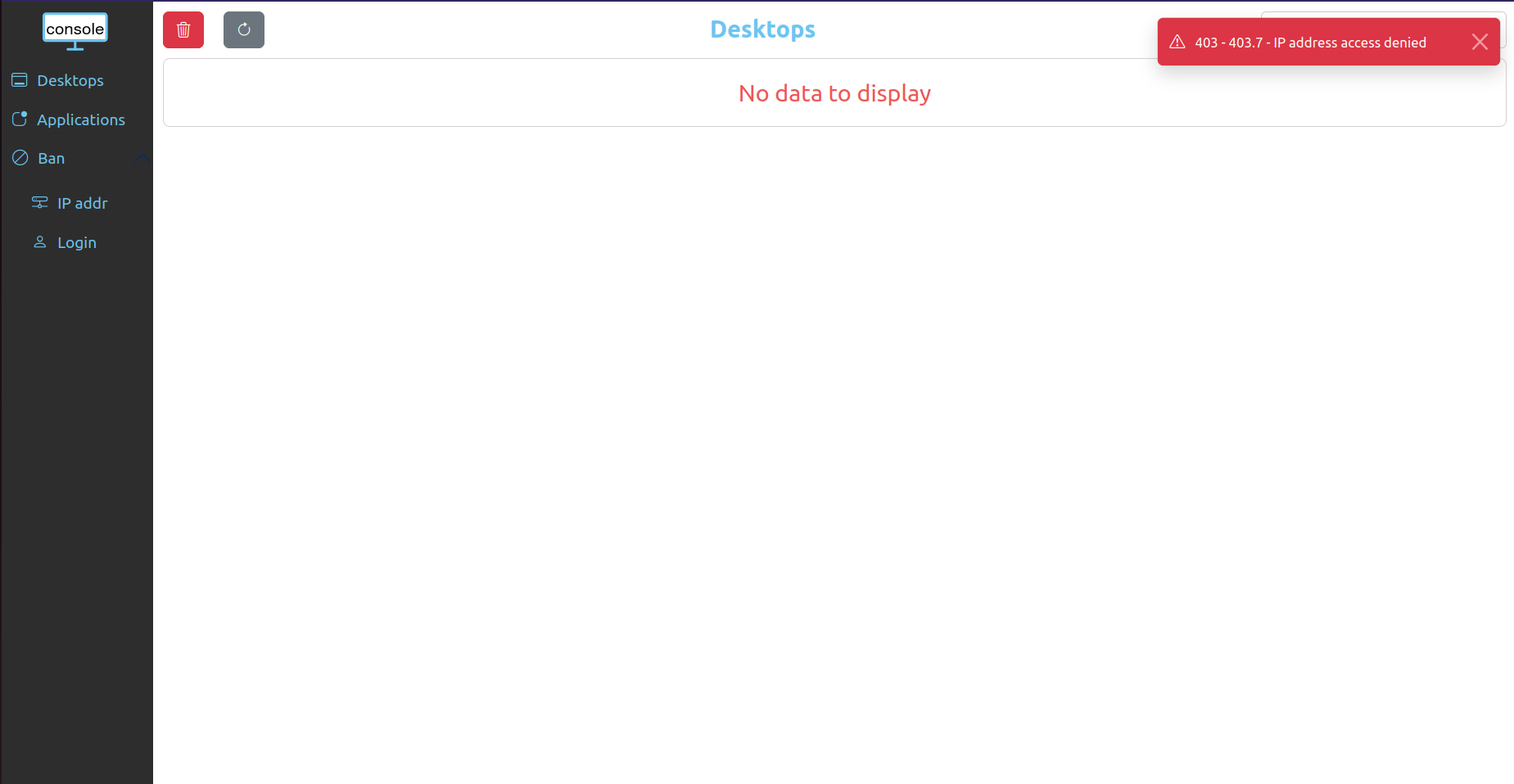
Retry connecting to the console. You should now see an error message in the top-right corner:
You can also check the logs of Pyos, you should see your public IP address as source IP
kubectl exec -it pyos-od-5c5cfdbfc8-t9r9m -n abcdesktop -- bash
Defaulted container "pyos" out of: pyos, wait-for-mongo (init)
pyos-od-5c5cfdbfc8-t9r9m:/var/pyos# tail logs/trace.log
2026-02-06 16:25:25 abcpool1-node-fa2594 139923622185784 od [INFO   ] __main__.trace_request:anonymous /healthz
2026-02-06 16:25:35 abcpool1-node-fa2594 139923627645752 od [INFO   ] __main__.trace_request:anonymous /healthz
2026-02-06 16:25:37 abcpool1-node-fa2594 139923618954040 od [INFO   ] __main__.trace_request:anonymous /manager/healtz
2026-02-06 16:25:37 abcpool1-node-fa2594 139923618954040 base_controller [DEBUG  ] controllers.manager_controller.ManagerController.apifilter:anonymous
2026-02-06 16:25:37 abcpool1-node-fa2594 139923618954040 base_controller [DEBUG  ] controllers.manager_controller.ManagerController.ipfilter:anonymous
2026-02-06 16:25:37 abcpool1-node-fa2594 139923618954040 base_controller [INFO   ] controllers.manager_controller.ManagerController.ipfilter:anonymous ipsource <your_public_ip> access is denied, not in network list [IPNetwork('10.0.0.0/8'), IPNetwork('172.16.0.0/12'), IPNetwork('192.168.0.0/16'), IPNetwork('fd00::/8'), IPNetwork('169.254.0.0/16'), IPNetwork('127.0.0.0/8')]
2026-02-06 16:25:37 abcpool1-node-fa2594 139923618954040 base_controller [ERROR  ] controllers.manager_controller.ManagerController.raise_http_error_message:anonymous 403.7 - IP address access denied
2026-02-06 16:25:37 abcpool1-node-fa2594 139923618954040 od [INFO   ] __main__.trace_response:anonymous /manager/healtz b'{"status": 403, "message": "403.7 - IP address access denied"}'
2026-02-06 16:25:45 abcpool1-node-fa2594 139923617876792 od [INFO   ] __main__.trace_request:anonymous /healthz
2026-02-06 16:25:55 abcpool1-node-fa2594 139923621108536 od [INFO   ] __main__.trace_request:anonymous /healthz